
Reading articles about smart labs and the future of laboratories leads us to look at many aspects from a different perspective.
There is one point where all these articles seem to converge: flexibility. No matter how many instruments, connected systems or automated solutions we incorporate, they all ultimately depend on a physical space that is capable of accommodating them and evolving with them.
Efficiency starts with how both the space and the process have been planned.
And if there is one thing we have learned, it is that we cannot know for certain what new advances will come or what the laboratories of the future will look like. Planning should therefore leave enough room to respond to those changes when they appear.
Flexibility has many faces
In recent years, advances in design, engineering and user experience have greatly expanded the possibilities we have when adapting spaces to people, processes and new equipment.
Today, there are many more options for avoiding excessively rigid configurations and for designing spaces with the ability to evolve from the outset.
And that flexibility can take many forms:
Space design
Keeping certain areas as open as possible can make future modifications easier. Completely fixed partitions can limit new configurations, so it is worth considering from the beginning which areas really need permanent separation and which could benefit from more adaptable solutions.
Service walls, panelled benches, sinks, cabinets and other elements can help organise and separate areas without necessarily making every decision permanent.
Service distribution
Electricity, water, gases, ventilation and data greatly influence the ability to move or reorganise a laboratory.
When the project allows it, distributing certain services from the ceiling can make future reconfigurations much easier, as furniture becomes less dependent on fixed connection points in walls or floors. Connections are also part of the flexibility of the space.
Process organisation
Flexibility also has to coexist with a well-planned workflow. Assigning areas according to processes, maintaining logical routes and avoiding unnecessary movement directly influence work efficiency and people’s comfort.
Ensuring that workers do not have to continuously move around the laboratory to access equipment, that samples do not cross areas where they should not, that there is sufficient storage space or that work surfaces can remain organised are decisions that end up affecting everyday work much more than it may seem.
Furniture selection
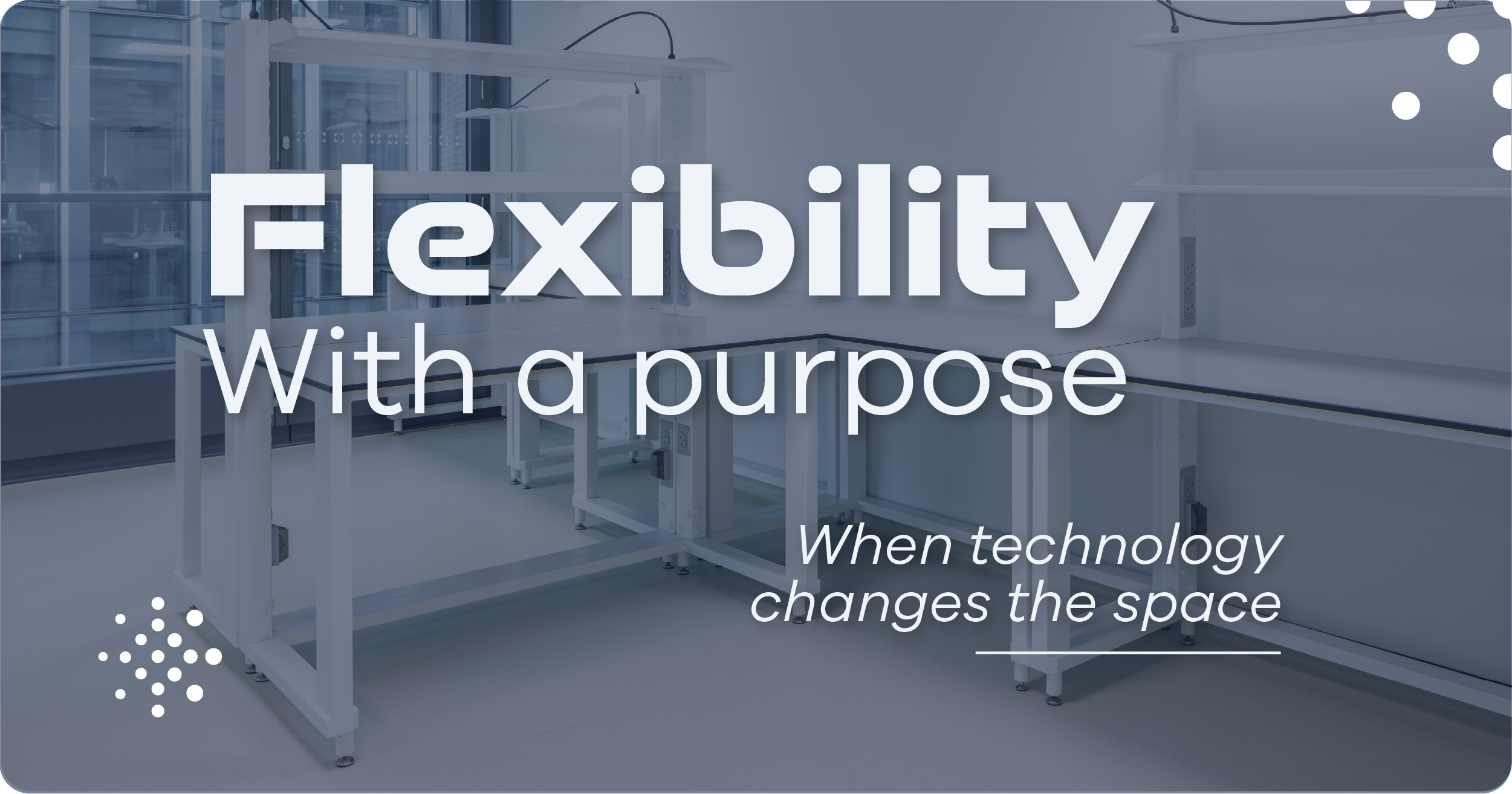
This is one of those decisions that is sometimes made too quickly. In many cases, the full possibilities offered by a well-designed system are not known, and the focus ends up being only on dimensions, materials or load capacity. But furniture also determines how much we will be able to modify the laboratory later.
If benches, storage and accessories can be combined with one another, moving a piece of equipment or rethinking a work area does not necessarily mean starting from scratch. Mobility, the ease of connecting and disconnecting services, and the possibility of adding, removing or readjusting elements when the work changes also matter.
Equipment layout
Ensuring easy and comfortable access for equipment technicians will also save us costs and time during inspection and maintenance processes, as these will be quicker and easier.
Flexibility is not always physical
Not long ago, I was listening to a conversation between a technician and an engineer about the needs of a particular space. It was not a laboratory, but the technician’s own workspace. He was wondering whether he could have a table with a specific feature to make it easier to access every part of the equipment.
The answer to that request also depends on how we understand flexibility.
In this case, it is not about moving a table or changing a module. It is about understanding a specific need and adapting the design to solve it.
And the same idea can be applied to many other decisions within a laboratory.
Sometimes the space needs to change. Sometimes the process changes. And sometimes we simply need to ask ourselves whether there is a different way to solve the problem.
So, is flexibility what really make a lab smart?
Flexibility may not be the most eye-catching element when we talk about smart labs. It is much easier to talk about artificial intelligence, robots, automation or new equipment. But when any of these things change, flexibility is what determines how much everything else has to change too.
Perhaps, then, a future-ready laboratory is not one that tries to anticipate everything that is yet to come, but one that leaves enough room to adapt when it arrives.
To explore this and more, join the conversation on our LinkedIn profile.
Thanks for reading,
IBR.