
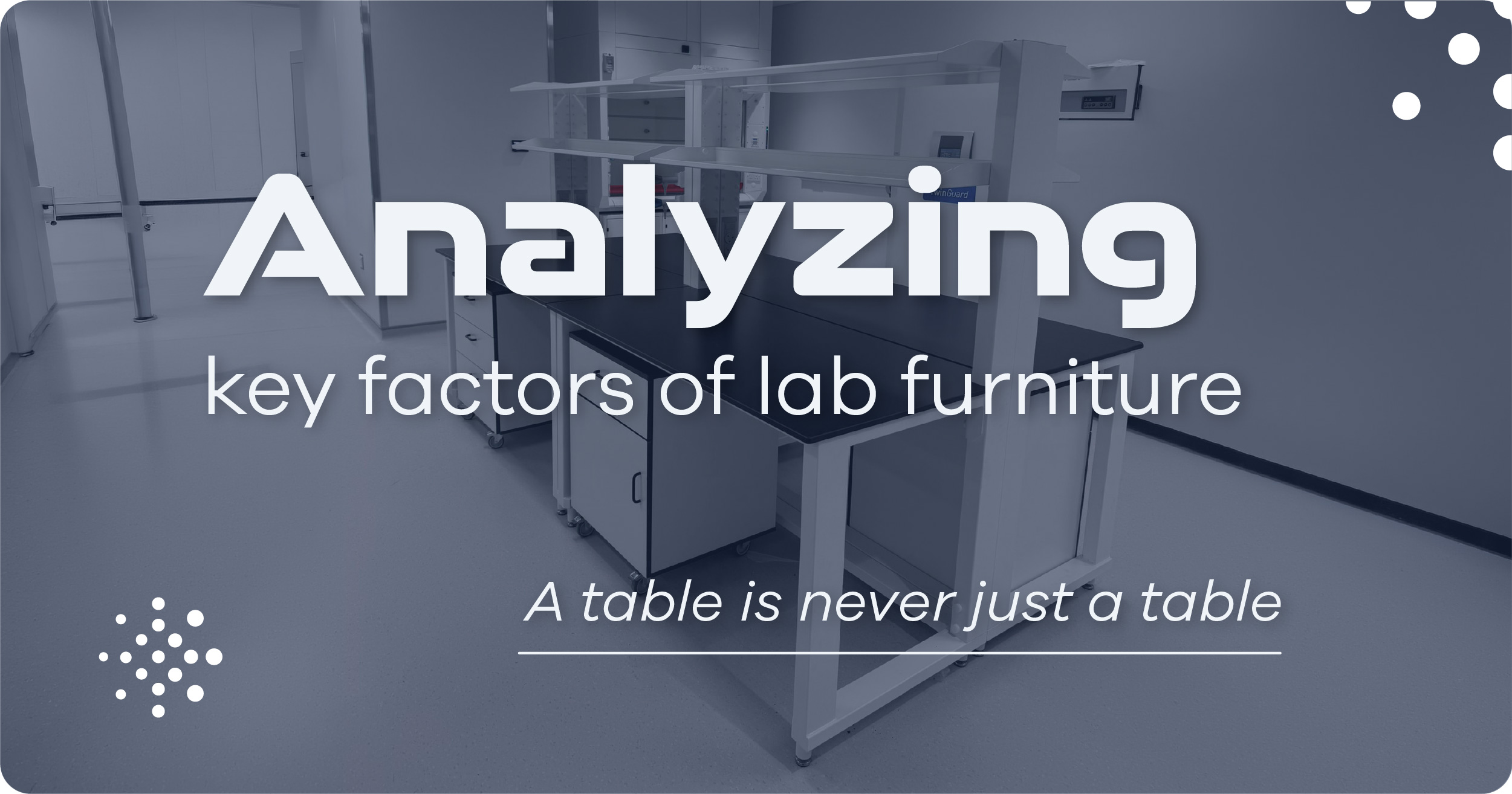
A table is never just a table
As we have previously discussed on our Beyond Labs blog, automation, Artificial Intelligence, and new instruments are fundamental tools for advancing toward a more effective and innovative science, but they are not everything.
The space itself, and how we build it, also plays a critical role in allowing all these advances to reach their maximum potential.
If we do not take this into account, we can find ourselves in situations like the one reported by Lab Design News: a laboratory acquired new, state-of-the-art equipment. The problem? It remained unused for months because the space needed to be renovated before it could be installed. [1]
We may have the technology, but we need a space prepared to accommodate it. And that is why:
A TABLE IS NEVER JUST A TABLE.
We cannot guess what new equipment will exist in the future or what needs will arise, but the decisions we make in the present will determine our ability to evolve at the same pace as new advancements and procedures.
When we choose a piece of furniture for our laboratory, we are also choosing how easy it will be to make future changes. This involves issues ranging from structural elements—such as electrical and gas connections—to more functional ones: the possibility of incorporating new accessories, mobility, load capacity, the materials the furniture is made of, or how it can adapt to the people using it.
These are decisions that may seem minor when designing a laboratory for the first time, but they become crucial when the time comes to change it.
So, what should we look for before choosing laboratory furniture?
Key factors
1. Modularity
Can the configuration evolve? Modularity is one of the first aspects we should consider. A laboratory changes projects, equipment, personnel, and procedures, and its furniture should be able to accompany those changes. However, it is worth looking beyond the word “modular.”
Different elements can be combined? Can we add or remove modules easily? Can we modify the setup without dismantling the entire workstation? How much time is needed, and does it require specialized installers?
The technical bulletin Designing Flexibility into Laboratory Benches (NIH) [2] notes that with traditional systems, modifications often require dismantling and contractors if components are permanently fixed. Flexible systems allow these modifications to happen rapidly and with minimal disruption.
2. Mobility
Can we easily reorganize the lab? A mobile drawer unit can move from one station to another. A mobile table can allow you to modify a workflow or make room for new equipment. Mobility expands the laboratory’s layout possibilities, but practical details matter: What load can the casters bear? Do they have a proper locking system? Does the furniture remain stable? Can it be moved with the equipment installed, and what happens to its connections?
Prudent Practices in the Laboratory recommends combining fixed elements (like fume hoods and sinks) on the perimeter with mobile carts and adjustable tables in central areas to maximize flexibility [3].
3. Load capacity, stability, and vibrations
A table may be the right size and still not be the right table for the equipment you intend to place on it.
When working with robust, delicate, or high-cost instrumentation, you must verify the maximum load capacity, structural robustness, and stability. It is also worth leaving a margin for the future. Additionally, some precision equipment requires specific stability and rigidity conditions regarding vibrations to function correctly.
4. Materials
Choosing based on lab usage. Not all laboratories handle the same substances or operate under the same conditions. If you are using corrosive products, chemical agents, or have specific cleaning protocols, you must check the technical specifications of the surface materials. Chemical resistance, durability, and ease of cleaning directly impact the furniture’s lifespan. You should seek the right material for the specific use of each work zone.
5. Open systems
Can we integrate new needs? A table might start as a relatively simple work surface and require new elements as a project evolves. Shelves, lighting, monitors, storage, electrical outlets, and support arms may be needed later.
Working with open systems is vital here, allowing you to incorporate, remove, or reorganize elements without replacing the entire workstation.
6. Ergonomics
The space must evolve with its people. Laboratory needs change, and so do the needs of the people working in it. Working heights, sit-stand options, legroom, the reachability of tools, and the ability to adjust certain components directly influence the daily laboratory experience.
A workstation that can adapt to different people, tasks, and working styles offers significantly more possibilities throughout its useful life.
7. Durability and sustainability
Considering the entire lifecycle. Sustainability is also part of the decision-making process. We can review material origins, manufacturing processes, and environmental certifications. We can also ask a very simple question: what will happen to this furniture when our needs change? If we can repair a part, replace a component, reuse a structure, or adapt an existing setup, we are extending the product’s lifespan. Designing for the future means making the most of what we already have for a longer time.
8. Electricity, data, and gases
Flexibility depends on connections. You might choose a mobile, modular table prepared for various accessories, only to discover that the facility’s fixed installations prevent you from moving it.
Electricity, data, gases, and other services must be considered from the beginning. In its report The Future of Labs, Gensler highlights the combination of modular furniture, mobile elements, and quick-connect services as essential for adaptable spaces [4].
Designing Today for Tomorrow’s Changes
The evolution of a laboratory does not depend on a single decision. It depends on many small decisions that, over time, begin to interconnect.
The table we choose. The weight it can support. The casters on a drawer unit. An electrical connection. The material of a surface. The ability to add a shelf three years from now.
At the time of designing the space, they may seem like minor details. When we need to reorganize, add a new instrument, or adapt a workstation, they no longer are.
Because when we choose a table, we are deciding much more than where we will work today, we are deciding what possibilities that space will have tomorrow.
Checklist & References
With the new season kicking off and FarmaForum 2026 just around the corner, let’s review a quick checklist of best practices when selecting your laboratory furniture:
Checklist: Before choosing laboratory furniture
- Can it be easily modified or expanded?
- Can it be moved safely?
- What load does it support and what stability does it offer?
- Are its materials suitable for the intended use?
- Does it allow for the integration of new accessories?
- Can it adapt to different people and tasks?
- Can it be repaired, reused, or upgraded?
- How will it connect to electricity, data, and gases?
To explore this and more, join the conversation on our LinkedIn profile.
Thanks for reading, 🔬
IBR.
References
[1] https://www.labdesignnews.com/content/what-we-really-need-a-conversation-with-lab-operators
[2]https://orf.od.nih.gov/TechnicalResources/Documents/Technical%20Bulletins/15TB/Designing%20Flexibility%20into%20Laboratory%20Benches%20-%20March%202015%20Technical%20Bulletin_508.pdf?utm
[3] https://www.ncbi.nlm.nih.gov/books/NBK55878/
[4] https://www.gensler.com/doc/2024-the-future-of-labs.pdf