
A shift in laboratory design
In our previous newsletter, we explored, from a broader perspective, where laboratory world is heading. We highlighted a clear shift: people are increasingly becoming the center of these processes.
For years, laboratory spaces have been designed with a very specific goal: to maximize every square meter and every minute of work. There is nothing wrong with pursuing efficiency and productivity. However, over time, new ways of thinking and new research have shown something key: we perform better when the environment is designed for us, not the other way around.
From efficiency to human-centered laboratories
This is why, in our previous issue, we addressed topics such as adaptive spaces, sustainability, and how these factors are redefining Laboratories 4.0.
In this second issue, we want to bring these ideas down to a much more tangible level: ergonomics.
Because when we talk about human-centered design, ergonomics is one of its clearest expressions.
Understanding laboratory ergonomics
Philosophers and sociologists have linked the state of a society to the quality of its environments, just as individual well-being has been linked to the fulfillment of basic needs.
When we are in survival mode, we do not think about aesthetics, comfort or optimization.
Society works in a similar way, but on a larger scale.
As we evolve as individuals —through research, education and technological progress— society evolves as well. This allows us to rethink the spaces we inhabit, seeking a more balanced relationship between aesthetics, functionality and adaptability.
Why ergonomics matters in laboratories
This is where laboratory ergonomics comes in.
Not only as a discipline within industrial or product design, but as a tool that can improve our daily work and, consequently, our results.
That is why, even though much of the conversation focuses on innovation, new technologies or automation, if we do not pay attention to something as fundamental as the workspace itself, friction will remain.
We may have a fully automated laboratory, but if the environment is not properly designed, certain tasks will remain uncomfortable or inefficient, and safety may even be compromised.
Designing from the ground up
Laboratory ergonomics starts at the planning stage, when designing a space:
- How it is organized
- How it is distributed
- How its real use is considered.
The role of furniture in laboratory ergonomics
Then comes an important decision that often goes unnoticed: the furniture.
When selecting the elements that will shape a laboratory, we usually look for something that simply “does the job”. But this is where it becomes necessary to go one step further.
Concepts such as sustainability and waste reduction come into play, and this is where design with purpose becomes essential.
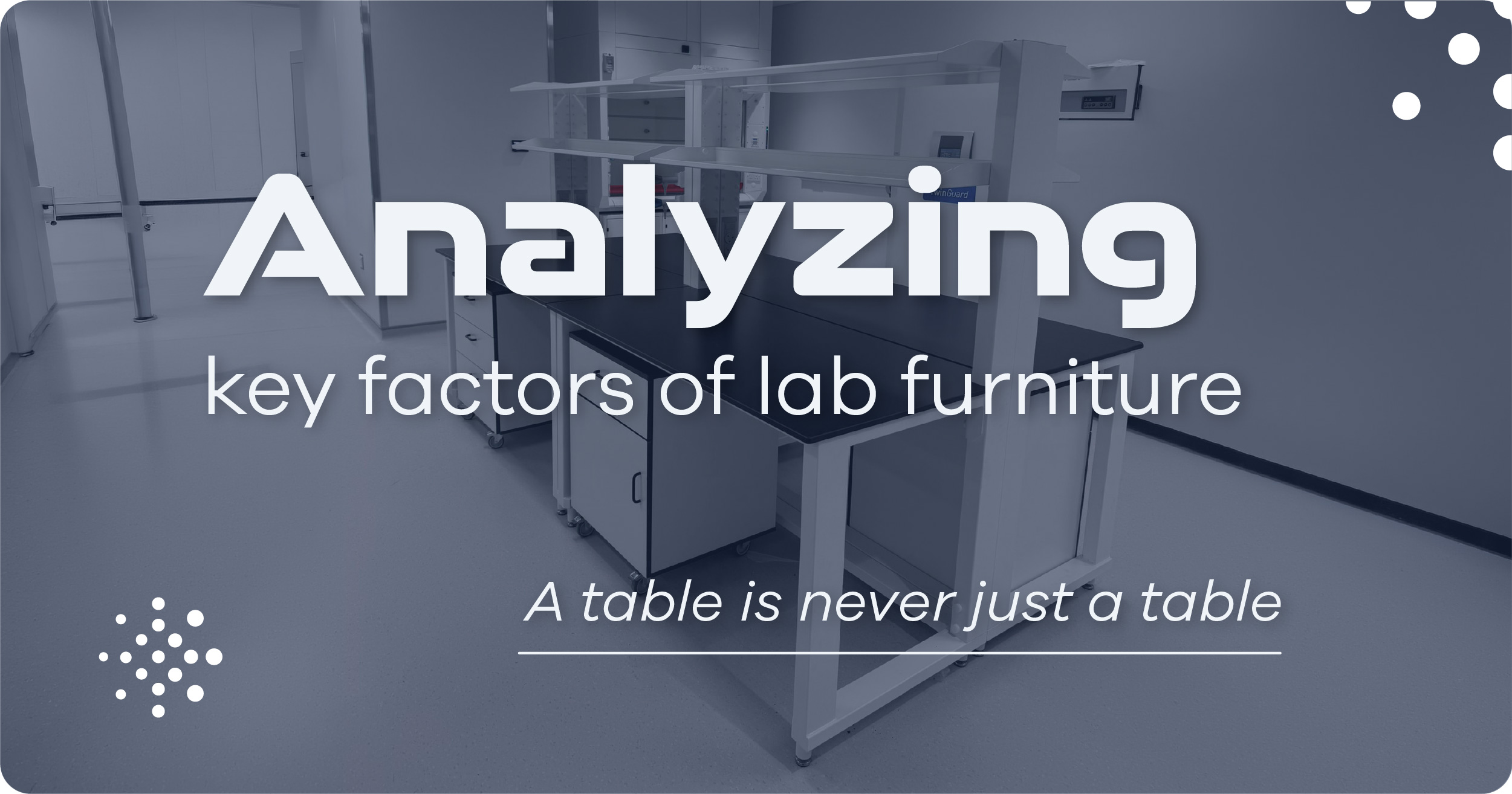
A table is never just a table
A table is a table, but a table designed with intention can adapt to different ways of working and different needs. It can become almost anything we need it to be.
Adaptability and modular systems
In this sense, modular systems and the possibility of incorporating accessories allow the workspace to better adapt to the pace of the person using it, enabling both the work and the space to evolve together.
Let us imagine, for example, that new people join a team. New workstations need to be integrated without disrupting the rest.
If the environment is not prepared, this can lead to complex changes or even interruptions in activity. However, with a flexible system, the team itself can reorganize the space easily, with minimal intervention.
Details define performance
Beyond layout, there is the furniture itself.
The possibility of adding or removing elements, like shelves, incorporating tools or supports when needed, or adjusting the height of the work surface allows the space to respond better to different situations.
Because ergonomics is also found in these small gestures:
- Being able to change posture
- Reducing physical strain
- Supporting precision work
The human factor
We have all experienced it at some point.
After several hours of work, there comes a moment when no position feels comfortable. We try to adjust, but what we really need is to stop, move, and reset.
If we do not, concentration begins to fade.
Designing spaces that adapt to people
Our body and mind function in a very specific way, and for a long time we have tried to adapt to rigid spaces and inflexible ways of working.
Now, we have the opportunity to do the opposite. We now have the ability to design environments that adapt to us.
More dynamic. More flexible. More human.
Conclusion
The shift is already happening. The question is no longer whether we should do it. The question is:
How far can we go in adapting our workspaces to meet today’s needs and expectations?
Continue the conversation
We invite you to explore this further in our newsletter.
Stay tuned for the articles we will be sharing throughout the month — we look forward to your thoughts at our LinkedIn profile.