

What is Laboratory Ergonomics?
As we have mentioned on previous occasions, good laboratory ergonomics takes into account the human factor involved in every task. This is important to consider, as many of the day-to-day activities carried out in a laboratory involve human interaction with laboratory elements.
It is not only about creating a space that is accessible to as many people as possible and as modular as possible so it can be adapted when necessary. It is about ensuring that the space is safe and supports workers’ productivity (which also depends on other factors such as workplace comfort, taking appropriate breaks, and a good distribution of workload).
Laboratory Ergonomics through the lens of User Experience (UX)
In User Experience (UX), we study how users interact with an environment, whether digital or physical, and focus on how they carry out each action, identifying potential friction points as well as strengths in every interaction.
Smart laboratory design follows a very similar approach: interactions between workers and their environment are studied in order to create a space that is as safe and efficient as possible.¹
As we explained in the newsletter, laboratory ergonomics depends on many factors involved in the design and configuration of the space.
The role of Laboratory Managers and Decision-Makers
The first parties involved are owners and laboratory managers, those responsible for decision-making and for ensuring team safety.
Matthew D., author of the referenced article, explains that they are the ones who can work closely with technicians and scientists in their laboratories, ask questions, gather feedback, and identify friction points in their processes.
This is perhaps the most important aspect, and one that is often overlooked: direct contact with users, feedback, and an iterative system of continuous improvement.
The fundamental pillar of the User Experience field is to understand what our potential users experience and feel. This is why it is important not to overlook the experiences of those who work in the laboratory every day and how these experiences affect their daily work.
Understanding Ergonomic challenges in laboratory work
To design a truly ergonomic space, we must understand how the work carried out within it functions and how the human body responds to those tasks.
Laboratory work often involves repetitive tasks, static positions, or actions that require a high level of precision. In these situations, friction points may arise that can easily go unnoticed at first glance, such as:
- Constantly reaching for poorly placed materials
- Working at unsuitable heights
- Maintaining a comfortable posture over prolonged periods of time
Various studies show that factors such as fixed work surfaces, non-adjustable heights, forced postures, inflexible furniture, and poorly positioned equipment can result in muscle strain, fatigue, neck, lower back and shoulder discomfort, reduced efficiency, and decreased comfort during long tasks.
What is a Neutral Posture?
As a solution, the concept of “neutral posture” is proposed.
This means that the body should work in a position of minimal physical strain, specifically:
- Neck in a neutral position
- Relaxed shoulders
- Straight wrists
- Arms close to the body
- Properly aligned back
Helping to achieve more natural and relaxed postures is one of the objectives of ergonomics. Therefore, it is not only about the furniture itself, but also about how it is organised.
Reach Zones: Organising the Workspace Efficiently
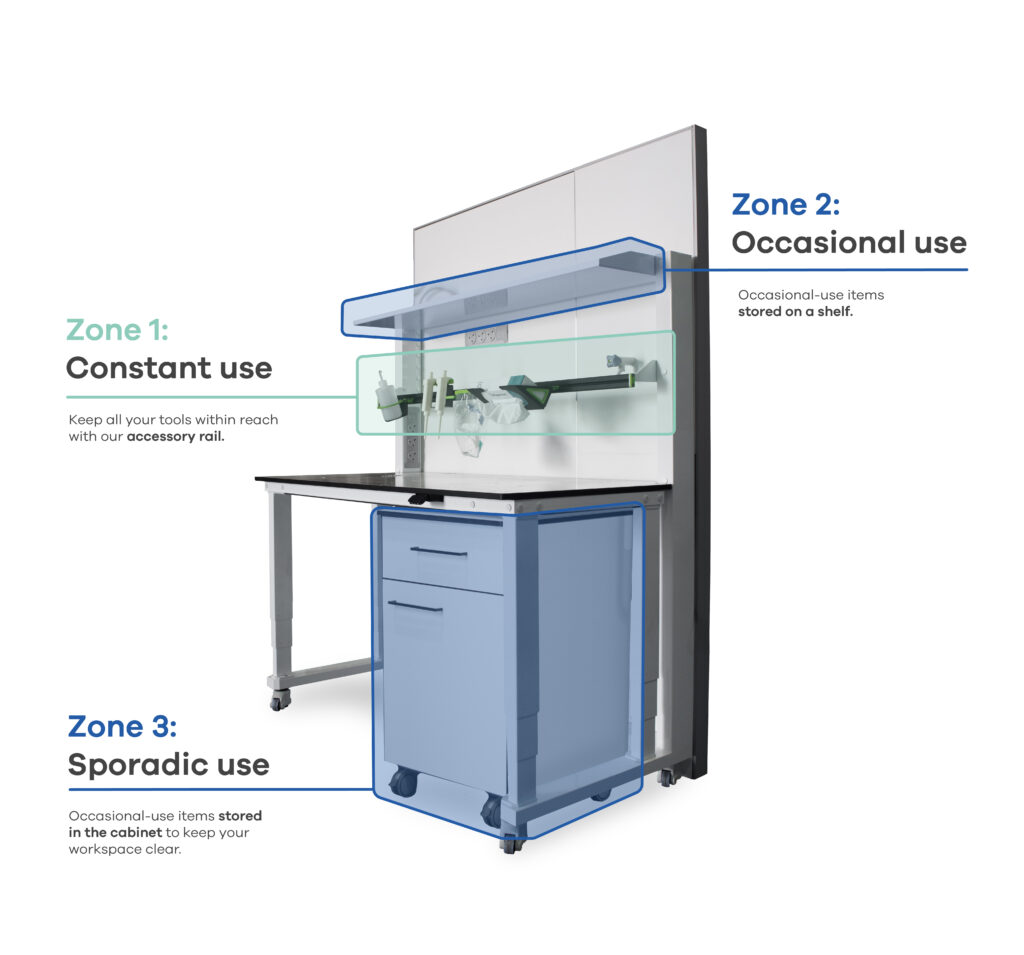
This paper [view paper] discusses “reach zones”, which involve dividing the workspace according to how frequently each area is used.
Zone 1: Constant Use
Items positioned in front, visible, and easy to reach.
Zone 2: Occasional Use
Items requiring slight arm extension.
Zone 3: Sporadic Use
Items requiring full movement.
Here you can see an example of how reach zones are organised using IBR elements:
This is why we continue to reinforce the importance of modularity in these types of workspaces.
If the organisation changes and the reach zones need to be restructured, we must ensure they can be easily reconfigured, so that even technicians themselves can do it with ease, as is the case with plug-and-play systems and modular systems.
Modularity in Laboratory Design
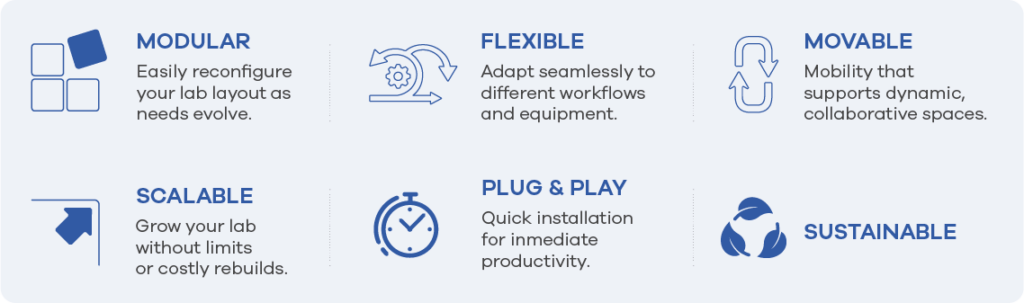
At IBR, we understand the importance of this factor and have designed the Primary System based on these principles.
In addition, our entire product range is fully compatible, allowing accessories to be added and/or removed quickly and easily whenever needed. These are our core values:
Why Work Surface Height Matters
Another point strongly highlighted in this paper is the issue of work surface height.
The same workbench is not suitable for every task, precisely because different activities require different surface heights. There are established standards that define different height ranges depending on the type of work being carried out:
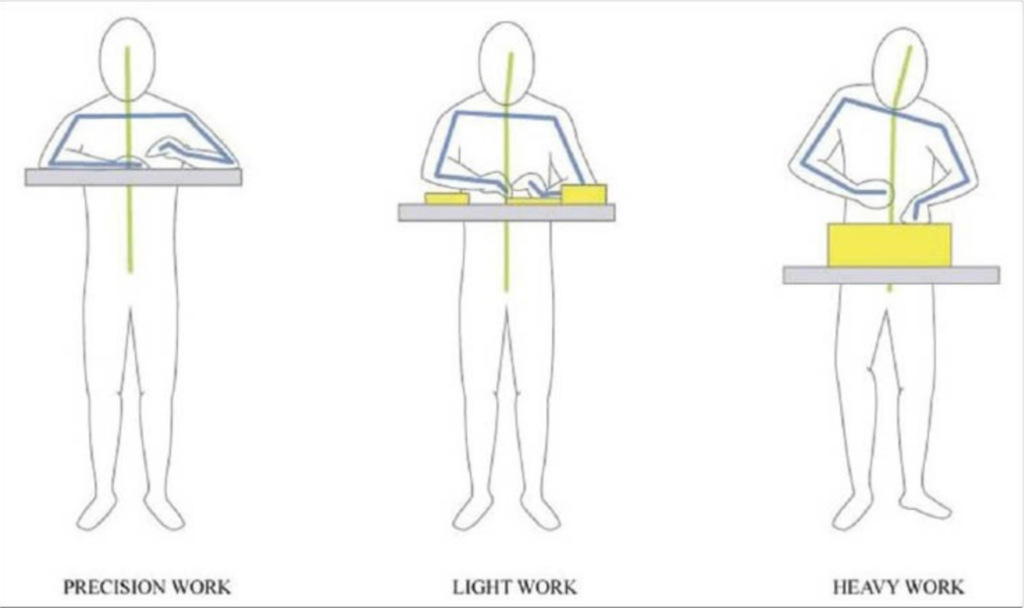
For this reason, it is important to have height-adjustable surfaces.
Additional Factors That Influence Laboratory Ergonomics
Matthew D. also highlights other important elements, including:
- Air quality
- Good lighting (adjustable whenever possible and predominantly natural)
- A quiet and calm environment
Designing Laboratories Around People
In conclusion, an efficient laboratory, a Laboratory 4.0, is not simply one that looks modern, bright, and equipped with the latest technology.
Attention must also be paid to the layout of laboratory furniture and elements, whether work areas are designed efficiently (through reach zones), whether surfaces and supports such as chairs and stools are height-adjustable, and whether collaborative spaces are encouraged while still ensuring a quiet environment free from disruption between workspaces and processes.
At IBR, we are committed to designing the future of laboratories by placing people at the centre, facilitating day-to-day tasks and, in doing so, supporting the future of science.
Continue the conversation
We invite you to explore this further in our newsletter.
Stay tuned for the articles we will be sharing throughout the month — we look forward to your thoughts at our LinkedIn profile.
Thanks for reading, IBR
References
- CRB Group – Design Considerations for Laboratory Ergonomics by Matthew Decker, Architect (article here)
- PMC – Laboratory Ergonomics Paper (paper here)